Three-Point Shooting vs. Field Goal Percentage

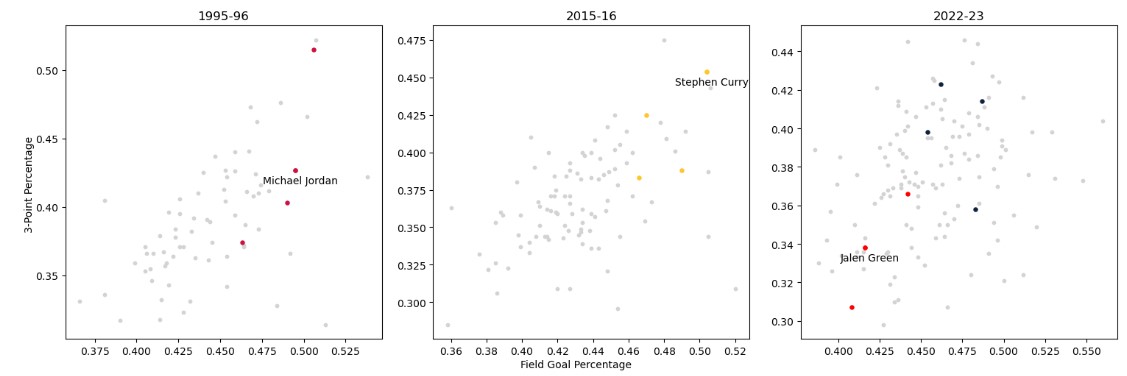
Strictly from an eye test, as an NBA enthusiast, one of the most noticeable changes in the NBA has been the increasing significance of the three-point shot. In the 1995-96 and 2015-16 seasons, there appears to be a positive correlation between 3-point percentage (3P%) and field goal percentage (FG%). Michael Jordan and Steph Curry, along with their teammates, were very efficient in respect to their opposition. Steph Curry nearly sets himself apart entirely in terms of efficiency in both metrics. In the 2022-23 season, we see a shift in the utilization of the 3-point shot, where we see significantly more variance in this relationship. Nikola Jokic is not represented in this graph due to his low volume of 3-point shots; Jalen Green did not exemplify the same level of efficiency compared to his peers, but he holds plenty of potential for improvement.
Free Throws and Field Goals: An Evolving Dynamic

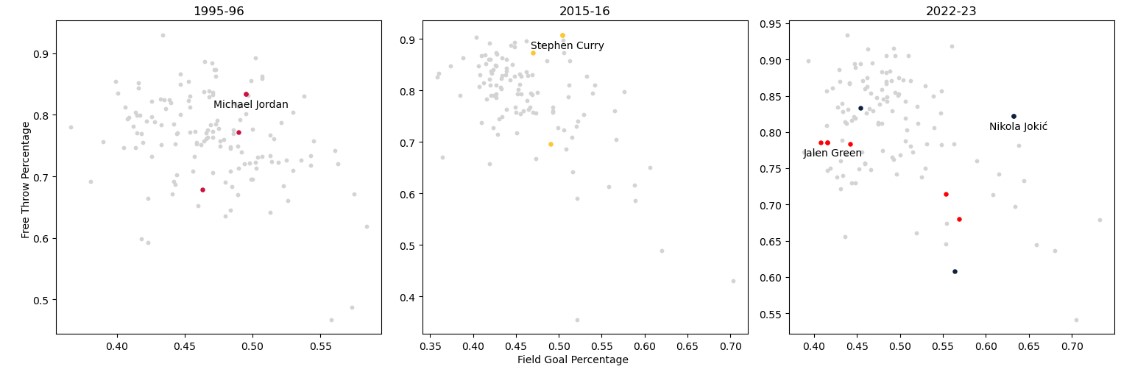
When analyzing the correlation between free throw percentage (FT%) and FG%, the data reveals interesting contrasts. The 1995-96 season exhibited more variance, while the 2015-16 and 2022-23 seasons showed a negative correlation. This suggests that as the league progressed, players who excelled in field goals were less likely to be strong free-throw shooters, with exceptions like Nikola Jokic, who managed to maintain high efficiency in both areas. Jokic’s ability to excel in both FG% and FT% sets him apart, particularly as a center, a position traditionally known for struggling at the free-throw line.
Effective Field Goal Percentage: A Consistent Indicator of Success

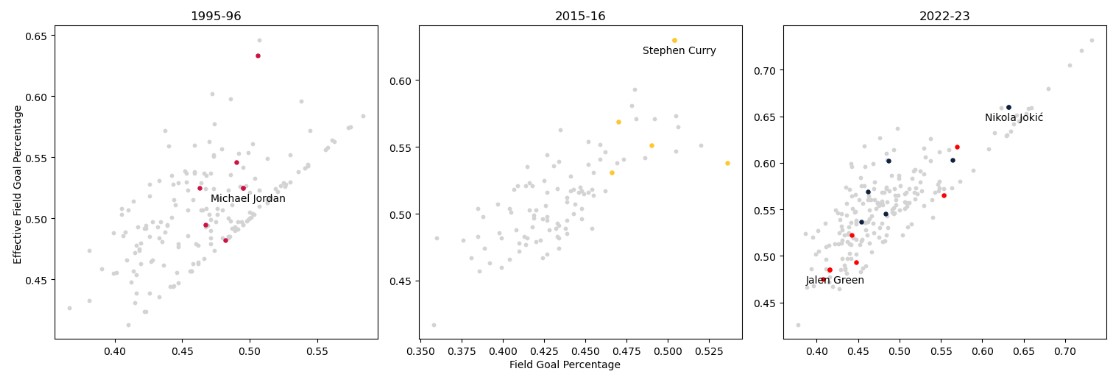
The relationship between effective field goal percentage (eFG%) and FG% has remained consistently strong across the three seasons analyzed. This is expected, given that eFG% is an advanced metric that builds upon FG% by accounting for the added value of three-pointers. The players who perform well in this metric are often the same players who are efficient in traditional FG%, with Steph Curry again emerging as a standout in this area.

Positional Changes: The Rise of the "Shooting Big"

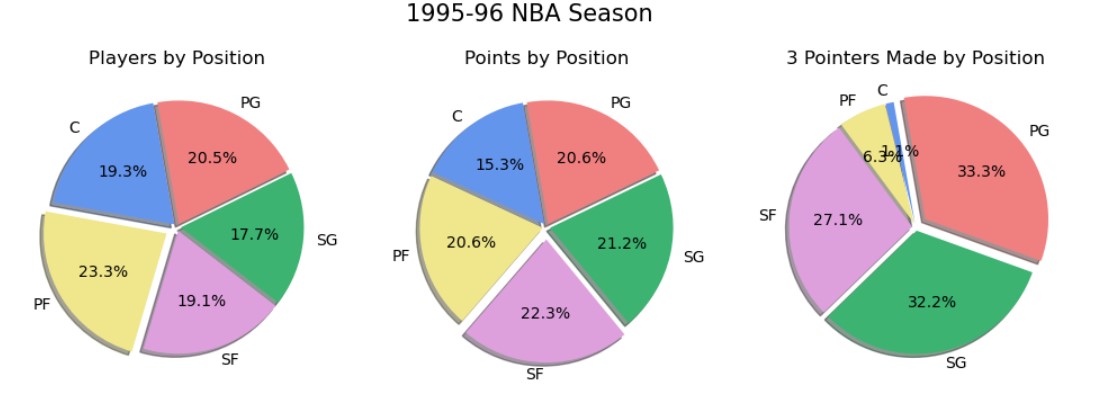
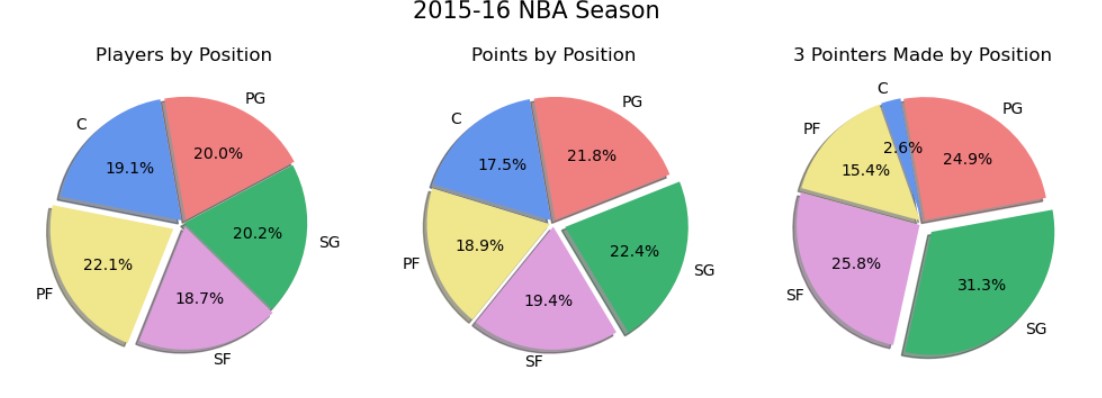
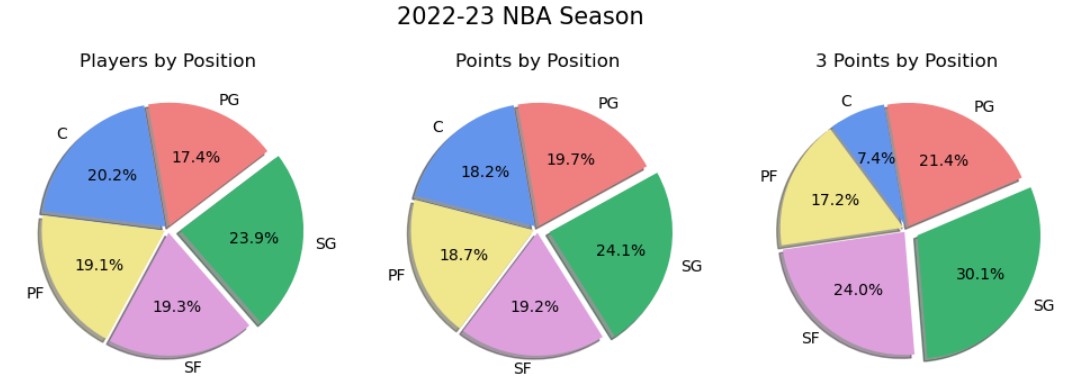
While the number of players per position has not shifted drastically, the roles and contributions of these positions have evolved significantly. Historically, shooting guards dominated three-point shooting. However, by the 2022-23 season, we see a more even distribution of three-point attempts across positions, with centers and power forwards contributing more from beyond the arc. This shift suggests that the NBA is moving toward a model where "shooting bigs" are becoming more common, while point guards are not necessarily relied upon as primary three-point shooters.

3-Pointers by Team

This graph showcases the distribution of 3-point attempts by each team for the Center (C), Power Forward (PF), and Point Guard (PG) positions. Each NBA team has clearly shifted in the distribution of shot attempts for these positions. Some teams, like the Atlanta Hawks, likely experimented with "shooting bigs" in the 2015-16 season but resorted back to traditional shooting in the 2022-23 season. This shows that although there are overall swings with the NBA, some teams may still opt for the traditional route. But, as Hawks fans are well aware, this has not led to championship success.

Statistical Increases: The Modern NBA’s Offensive Explosion

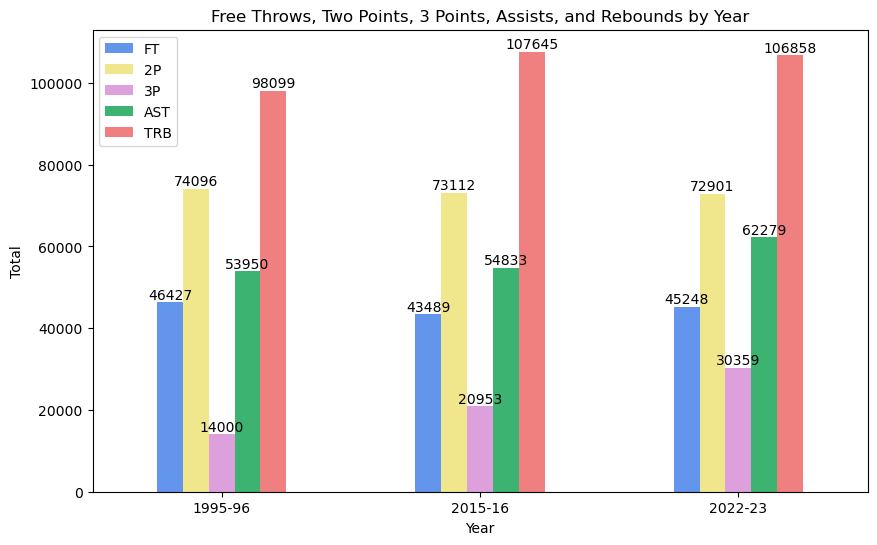
Across all three seasons, there has been a noticeable increase in points, assists, and rebounds, with three-pointers seeing the most significant rise. This trend underscores the growing emphasis on the three-point shot as a primary offensive weapon. The increase in these statistics is a testament to the evolution of the game, where teams are not only scoring more but also relying heavily on the three-point line to do so.


Final Thoughts

Comparing Generational Talents: Jordan, Curry, Jokic, and Green

When comparing the individual performances of Michael Jordan (1995-96), Steph Curry (2015-16), Nikola Jokic (2022-23), and Jalen Green (2022-23), it’s clear that each player’s success is reflective of their era. Curry’s 2015-16 season stands out as one of the most efficient in NBA history, especially in terms of shooting. However, it’s important to remember that basketball is a team sport, and while individual performances are crucial, the success of players like Jordan and Jokic also depended heavily on their teammates.

The Future of the NBA: What’s Next?

As the NBA continues to evolve, one question looms large: What’s next? With three-pointers becoming more prevalent, could we see the introduction of a four-point shot or a deeper three-point line to add a new layer of strategy? Or is the current state of the game, with its emphasis on three-point shooting and positional versatility, here to stay? Only time will tell, but one thing is certain—the NBA will continue to change, just as it has over the past few decades.